
Supplier changes / specification control
A familiar size number is a starting reference, not a cross-brand specification. Keep the current item, candidate drawing, measured sample and approval decision together before treating a replacement as equivalent.
The short version
Replace assumptions with an identifiable product record.
Keep the familiar size number, but do not let it do the whole job
If you are replacing an established horseshoe line, the fastest-looking route is to send the old model name and ask for the same sizes. That may start the conversation, but it leaves too much unresolved for an order. Your current size label is useful for identifying what your customers buy. It is not, on its own, a complete specification for a different model.
A better approach is to build a short matching record that travels with the product from the first enquiry to sample approval. It should connect the existing item, the RELIA candidate, the dimensions being compared and the differences still under review. This article describes that purchasing workflow. It is not a universal size-conversion chart, and it does not decide the suitability of a shoe for an individual horse.
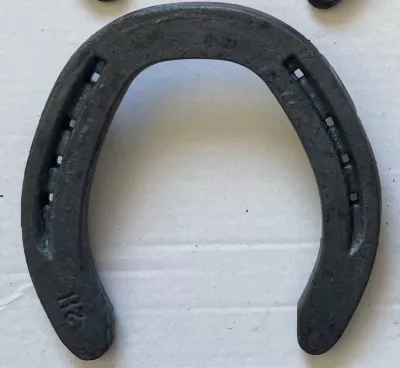
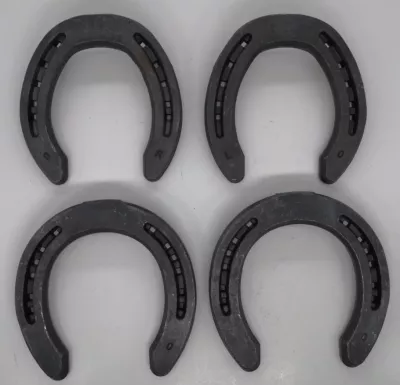
For a concrete catalog starting point, use RELIA's forged steel training-and-competition listing or its forged steel wholesale listing. Treat those as identifiable candidate products, not as evidence that either is already equivalent to the line you currently stock.
Collect the reference your team actually uses
Start with the current product as your warehouse and customers know it. Record the supplier, model, size label, front or hind designation, and the code on your own purchase or stock system. Keep any current drawing, specification sheet and approved sample together. If those references disagree, resolve the conflict internally before asking another supplier to reproduce the item.
A photograph of a box can help identify a line, but the item inside is the relevant physical reference. Likewise, an old sales description may be less precise than the drawing used for the latest purchase. Note which document governs the comparison instead of giving every attachment the same authority.
If you have several generations of the same model, label them separately. It is easy for an experienced buyer to recognize the difference and forget that a new supplier cannot. Explain whether the new candidate is intended to replace the current item exactly or to introduce an approved change. Those are different review tasks, even if the same familiar size number appears in both.
Define the comparison before looking for a match
List the characteristics that will determine whether a candidate can move to sampling. For a horseshoe, this may include the overall geometry, section dimensions, front or hind pattern, clips and nail-hole arrangement. Use the actual requirements of your product line; do not copy a dimensional checklist and assume every entry is equally critical.
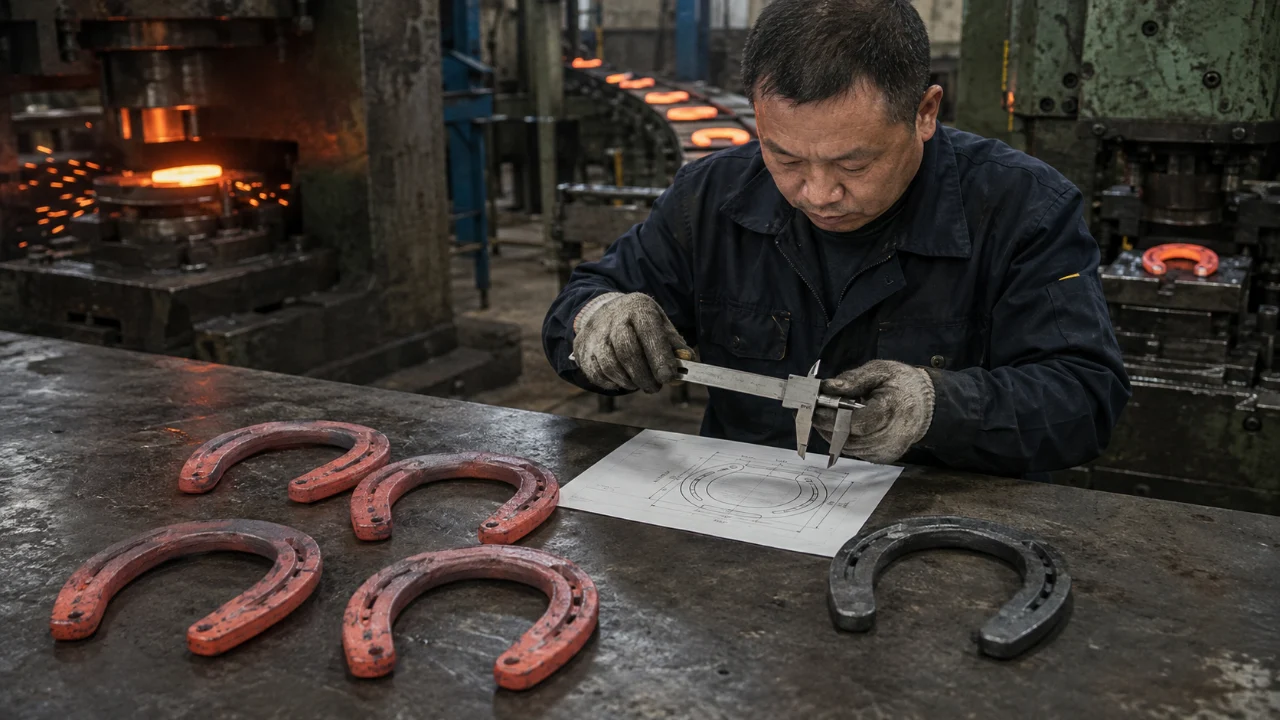
Identify the measurement points for each dimension. A number without a measurement location can look precise while remaining ambiguous. Keep the orientation clear in the drawing or marked reference image, and record the unit beside the value. Where the buyer and supplier normally use different units, agree which set of dimensions governs production.
At this stage, do not fill missing values from an online image or estimate them to make the spreadsheet look complete. Mark them for measurement or clarification. A visible open question is more useful than a guessed number that later appears in a purchase order as if it had been approved.
Keep front, hind and close variants on separate lines
A matching exercise becomes harder when several variants are grouped under one description. Create a separate line for each actual item you intend to buy. Keep front and hind patterns distinct, and do the same for clip arrangements or other features that matter to your range. A photograph that illustrates one version should not silently stand in for all of them.
The line should include your current reference, the candidate product link and a place to record the candidate's confirmed model or variant. If the supplier proposes an alternative, add it as an alternative rather than overwriting the original candidate. This preserves the reason for the change and prevents the team from losing track of which version it reviewed.
You do not need an elaborate system to do this well. A controlled sheet with stable item codes and a clearly named owner is often enough. The important point is that the quotation, samples and later order all refer to the same version of the list.
Use a comparison table that makes uncertainty visible
A useful table has more than two columns of dimensions. Include the characteristic, current reference, candidate value, unit or method, source and decision. The source might be an approved drawing, a supplier-confirmed specification or a measurement from an identified sample. The decision should distinguish a match, an acceptable difference and an unresolved point.
Do not turn the table into a score where missing evidence becomes a favorable assumption. If a candidate drawing has not yet been supplied, that row remains open. If a dimension differs, describe the difference without deciding automatically that it is better or worse. Its importance depends on the intended requirement and professional evaluation.
Avoid adding a single percentage match to summarize the table. Without a defined and justified method, that number can conceal the one difference that matters most. The buyer needs to see which features are accepted and which still need review, not a precise-looking overall score.
Build the comparison before deciding equivalence
This is a field guide to a buyer worksheet; it contains no claimed dimension or percentage match.
| Column | What belongs here | Decision value |
|---|---|---|
| Current reference | Identified existing model and approved source | Explains what is being replaced. |
| Candidate | Actual RELIA reference and variant | Keeps the proposed item distinct. |
| Characteristic | Dimension or feature, with unit and method | Defines what is compared. |
| Evidence | Drawing, sample measurement or specification source | Makes the value traceable. |
| Decision | Accepted difference or unresolved point | Prevents a guessed match. |
Request a sample that answers the open questions
Once the paper comparison is coherent, define what the sample must demonstrate. Identify the candidate model and size, the required material and finish, and the particular differences being evaluated. If you need samples from more than one variant, explain why. The supplier can then discuss the relevant sample arrangement instead of sending a convenient item that does not settle the decision.
Confirm sample quantity, charges and shipping arrangements separately. Do not assume that a sampling request reserves production stock or establishes the lead time for a later order. If the project requires a new design or tooling, the development steps should be agreed before the sample is treated as a standard catalog item.
When the sample arrives, keep its packaging and identifying reference with the review record. Record the date received and who will evaluate it. A sample without an identity can become surprisingly difficult to connect to an email conversation after several similar products have been received.
Measure, observe and assess suitability as different tasks
The sample review should separate what was measured from what was visually observed. Record dimensional results against the agreed measurement points. Photograph the finish and visible features using views that another person can understand. If the evaluation includes matching nails or other components, identify those components in the record.
A visual check does not establish material grade or every performance claim. Where the order requires material or test evidence, review the relevant documentation alongside the sample rather than allowing an attractive finish to stand in for it. Conversely, a management-system certificate does not remove the need to inspect the selected item.
Suitability for use on an individual horse belongs with an appropriately qualified farrier. This procurement record helps identify and compare products; it is not fitting advice or a clinical assessment. Keep any professional feedback within its actual scope and avoid turning a limited evaluation into a claim that the candidate suits every horse or application.
Resolve differences without losing the approved reference
A sample review may lead to approval, rejection or a request for change. Make that outcome explicit for each open characteristic. If the supplier is asked to modify a clip, hole position, section or other feature, identify the change in the drawing and record whether another sample is needed. Do not leave a mixture of accepted and unaccepted details under one blanket approved label.
When a revised sample is supplied, give it a new reference and compare it with the revised requirement. Retain the earlier record so the reason for the revision remains understandable. The purpose is not paperwork for its own sake: it is to stop an earlier sample, later drawing and informal email instruction from becoming three different descriptions of the product.
Before authorizing bulk production, confirm which drawing revision and sample reference govern the order. If any requirement remains outside the approval, identify it clearly and agree how it will be resolved.
Hand the decision to purchasing, receiving and future buyers
An approved comparison is useful only if the next person can act on it. Carry the final item code, model, size, front or hind designation, drawing revision and packing requirements into the purchase order. Keep the sample reference and acceptance record accessible to the team that will receive the shipment.
For a replacement range, update the internal cross-reference deliberately. State whether the old item is discontinued, retained as an alternative or being replaced only for certain sizes. Avoid changing a familiar stock code in a way that hides a substantive product change from the people who sell or use the range.
A repeat order should use the approved record rather than restarting from an old product photograph. If the candidate changes later, review the change before treating it as the same item. This is particularly important when several sizes share similar descriptions and the buyer placing the reorder was not involved in the original evaluation.
Keep the supplier change readable to the next team
The approved comparison should support purchasing, receiving and future reorders.
Current item
Identify the actual stock reference and governing documents.
Candidate review
Compare the same characteristics and label open points.
Sample decision
Record the accepted scope and any revision.
Order handoff
Carry one approved reference into purchasing and receiving.
Product references
Product links identify catalog examples; they do not confirm current stock or an approved specification.
Continue your review
Start the discussion with the information you already have
You do not need to finish every measurement before contacting RELIA. Send the current model reference, the proposed product link, your size mix and the destination, then explain which details still need confirmation. A physical sample or a controlled drawing can make the discussion more precise, but an honest list of open points is better than a complete-looking form built on assumptions.
Use the Horseshoe Sizes & Drawings guide for the basic specification checklist and the Samples & Approval guide for the approval record. If the project involves a new design rather than a catalog replacement, the OEM page explains how engineering and tooling decisions enter the process.
The desired outcome is straightforward: a buyer, supplier and receiving team should all be able to identify the same product and explain what was approved. That is a stronger basis for a supplier change than a familiar number, a similar photograph or an unsupported claim of equivalent performance.
Catalogue References Used in This Article
These links identify the examples discussed above. Confirm the selected variant, specification and packing for the actual order; a catalogue description is not a test result or a live stock confirmation.
Bring the Next Decision to the Team
Send your product reference, quantity, destination and the questions still open. A drawing or identified sample helps us discuss the actual requirement.