

Horseshoe Nails: Match the Type, Size and Fit
Choose a horseshoe nail as part of a shoe-and-nail combination, not by length alone. The head needs to seat in the shoe's nail hole, while the shank and length must suit the intended fitting. For a distributor, that means stocking nail references that connect to the horseshoes your customers use, rather than collecting several similar-looking sizes.
Our range includes E, ASV, T, JC and MX horseshoe nails. Use the length charts below to narrow your selection, then compare the head and shank with the shoe you want to supply. That gives you a clearer starting point for either an existing-range order or a replacement sample.
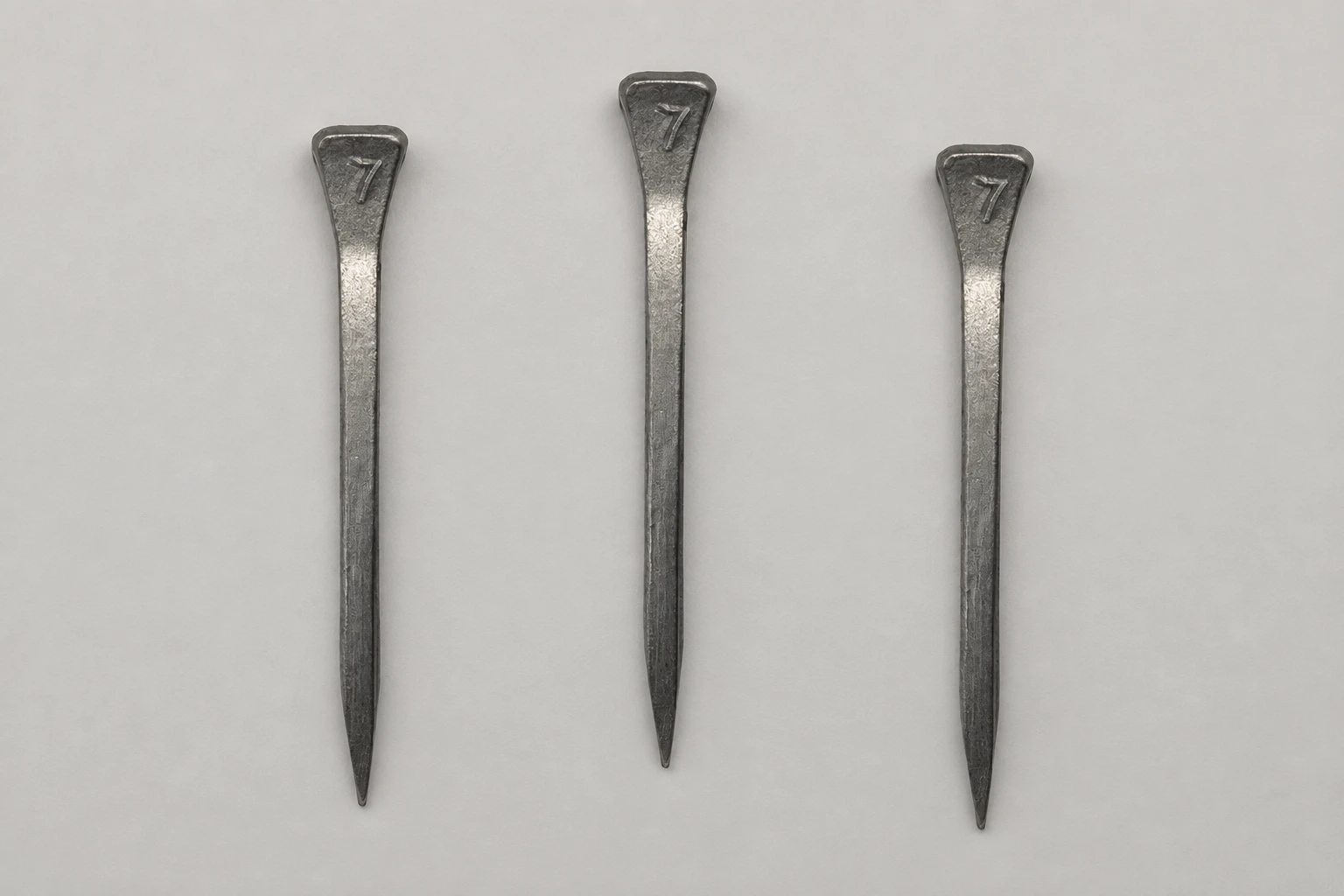
Length narrows the choice; it does not establish compatibility
E2, ASV2 and T2 are all listed at 41 mm in our catalogue. That shared length does not tell you that the nail heads and shanks are the same, or that all three will seat correctly in the same shoe.
The head profile and its seating in the nail hole are the first comparison. Shank shape, section and the intended shoeing application also matter. Keep the shoe model or a reference shoe with the nail sample so both parts can be evaluated together. Final selection and fitting belong with a qualified farrier; the purpose of the wholesale specification is to supply the correct, consistently identified combination.
Compare the catalogue lengths by series
The following are the listed lengths in millimetres. Each entry retains its full series designation so a size number cannot be confused with one from a different family.
On a small screen, swipe the table sideways to see all columns.
E and ASV — view catalogue lengths
| E series | Length | ASV series | Length |
|---|---|---|---|
| E1 | 37 mm | ASV2 | 41 mm |
| E2 | 41 mm | ASV3 | 45 mm |
| E3 | 45 mm | ASV4 | 47.5 mm |
| E4 | 47.5 mm | ASV5 | 50 mm |
| E5 | 51 mm | ASV6 | 54 mm |
| E6 | 54 mm | ASV7 | 57 mm |
| E7 | 57 mm | — | — |
| E8 | 60.5 mm | — | — |
| E9 | 63 mm | — | — |
On a small screen, swipe the table sideways to see all columns.
JC, MX and T — view catalogue lengths
| JC series | Length | MX series | Length | T series | Length |
|---|---|---|---|---|---|
| JC00 | 41 mm | MX50 | 50 mm | T2 | 41 mm |
| JC0 | 45 mm | MX55 | 53 mm | T3 | 45 mm |
| JC1 | 49 mm | MX60 | 54.5 mm | — | — |
| JC2 | 53 mm | MX65 | 57.5 mm | — | — |
| JC3 | 57 mm | — | — | — | — |
| JC4 | 61 mm | — | — | — | — |
| JC5 | 65 mm | — | — | — | — |
| JC6 | 69 mm | — | — | — | — |
Read the designation and length as two separate fields. MX55, for example, is listed at 53 mm; it should not become a 55 mm nail on a purchase order simply because “55” appears in its name. The same discipline is useful when translating labels or adding the range to an online catalogue.
Keep product weight separate from packing quantity
Nail weights can help estimate the metal weight of an order, but they do not define how many nails are supplied in a box. Our catalogue lists E5 at 3.0 g per nail and MX55 at 3.5 g per nail. An illustrative order of 10,000 pieces would therefore contain about 30 kg and 35 kg of nails respectively, before packaging.
This example uses catalogue unit weights; actual packing quantities and shipment weights are separate order details. Compare quotations using both the number of pieces and the agreed packing unit. For a boxed range, specify the nails per box, boxes per carton and required label; for freight planning, use the packed shipment weight.
Start a replacement with the customer's existing combination
If your customers already use a particular shoe and nail, a reference sample is more useful than a request for “the same size.” It preserves the head form, shank and point as well as the nominal length.
We can use your reference to identify a suitable option from our range. Keep the original and proposed references distinct during evaluation; only describe a replacement as compatible after the actual combination has been assessed. This avoids turning a similar name or length into an unsupported interchangeability claim in your own catalogue.
For a new steel or aluminum shoe range, select the shoe and accompanying nail together. Our steel horseshoe guide and aluminum horseshoe guide provide the starting points for those ranges.
Build stock around demand, not every available designation
A clear wholesale range distinguishes regular replenishment items from less frequent requests. Start with the nail references used by your existing farrier customers and the shoe ranges you intend to sell. Add other sizes when there is a defined customer need rather than assuming that a longer series is always a stronger assortment.
Keep your own sales code connected to the manufacturer's series, size and length. This matters when a customer reorders by a short code: the warehouse should still be able to identify the exact product without relying on memory or a similar-looking box.
At receiving, compare the labels and quantities with the agreed order and sample. Clear identification is a practical part of quality, particularly when several series and sizes arrive together.
A nail-and-shoe matching project for a UAE wholesaler
In 2024, a UAE wholesaler supplied two horseshoe types, three nail samples and a specification list for a private-label range. We reviewed the head, shank and point against the shoe references. One sample needed its head width reduced by about 0.2 mm after the first fit review.
The buyer evaluated two sample rounds, including nail-head seating, bending, cutting and surface condition. The initial order covered 480,000 nails in four lengths, packed 250 per branded box. Product labels, carton marks and barcode positions were confirmed with the packing artwork.
Those quantities and dimensions belong to this project. For your range, send the shoe and nail references, quantities by size and preferred pack count so we can review the proposed combination.
Buyer FAQ
Horseshoe Nail Buying FAQ
Check identification and compatibility before adding a nail to your wholesale range.
Can nails with the same length be used interchangeably?
Equal length does not establish compatibility. Our catalogue lists E2, ASV2 and T2 at 41 mm, but the head and shank still need to be compared with the intended shoe. Keep the shoe reference with the nail sample for the matching review.
Does the number in a nail reference always give its length?
No. Keep the complete series designation and the catalogue length as separate order fields. For example, MX55 is listed at 53 mm in our catalogue. Check the length table rather than converting the model number into a measurement.
What is needed to review a replacement nail?
Send the current nail reference or sample together with the shoe it is used with. Compare the head, shank and seating, not just the name or length. Keep the original and proposed references distinct until the combination has been evaluated.
Is the case-study box quantity a standard order condition?
No. The 250-nail boxes described in the UAE project belong to that order. Specify your own nail quantity, nails per box, label and carton requirements. Packing quantities and minimum order conditions are confirmed for the selected items.
Private labels that keep the nail easy to identify
Branded packaging should make selection simpler. Keep the series and size prominent, state the packing quantity and retain the reference that connects the box to the order. Where your market needs a barcode or buyer stock code, give it a consistent place in the artwork.
We support wholesale supply and private-label packing for horseshoe nails. Bring the product list and packaging brief together so the quotation covers both the nails and their presentation. Our packaging and labeling guide explains the wider packing considerations.
Explore the horseshoe nail range, or send us the nail reference and shoe you want to match. A series and size list is enough to start an existing-range inquiry; a sample is the better starting point for a replacement comparison.